Trade show follow up email: method and 5 templates
Send a trade show follow up email the same evening to priority leads and within two days to the rest. That timing is editorial advice, not a measured rule. Sort your leads first, then send a short message that picks up the conversation. This article gives the method, five templates, a phone script and a three-week sequence.
It extends our guide to trade show lead generation. It assumes each lead was annotated on the stand: need, timeline, commitment made.
When should you send a trade show follow up email?
As early as you can. The visitor met several exhibitors and memory fades fast. Here is a simple benchmark to adapt to your sector.
- The same evening: one very short message to the hottest leads, those who asked for a meeting or a quote.
- Within two days: the first message to every other lead, recalling the conversation.
- Within the week: calls, the documents you promised, meetings.
These timings are editorial advice. If the show ends on a Friday, a Monday morning email often lands better than one on Saturday: judge by your audience.
One point matters more than the timing: promise only the things you will deliver. If you write "I will send the documentation tomorrow", send it tomorrow.
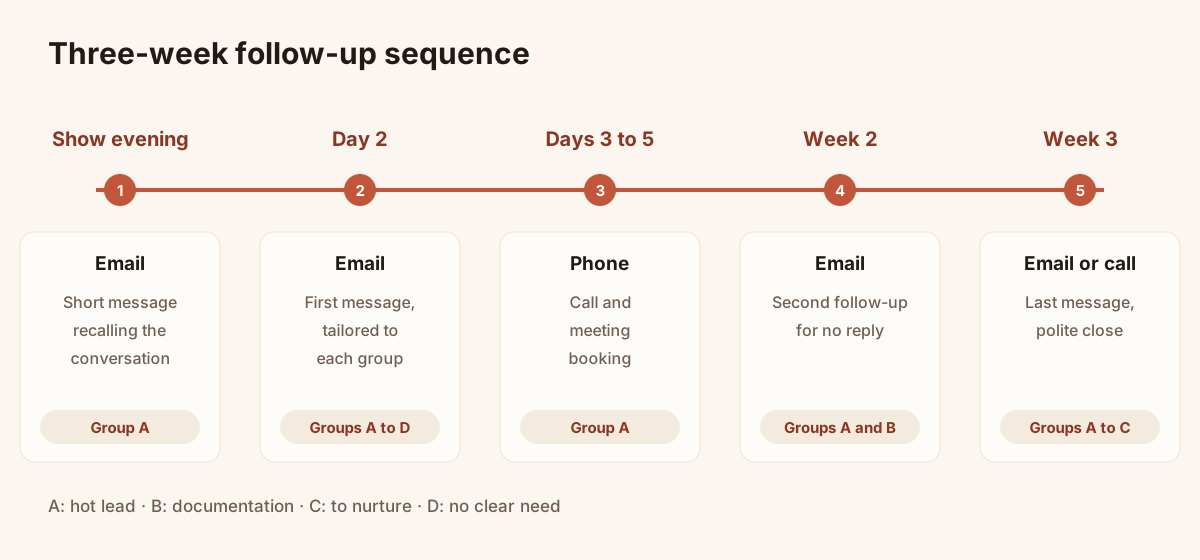
The follow-up sequence, from the evening of the show to week 3.
How do you sort leads before writing?
One message for every lead loses the best ones and annoys the others. Sort them into four groups, using your notes.
| Group | Signal | Action |
|---|---|---|
| A, hot | Clear need, near deadline, decision maker, meeting requested | Message the same evening, call within the week |
| B, documentation | Asked for a sheet, an offer or a price | Email with the promised document within two days |
| C, to nurture | Real need but distant timeline | Email, then useful content at spaced intervals |
| D, no clear need | Pleasant contact, vague need | Short thank-you message, no pressure |
In Piktechs, priority, tags, notes and form answers are attached to each lead. Filter by the show tag, then by priority. Voice notes are recorded, not transcribed: listen again before writing to group A. To define your criteria, read the guide to lead qualification.
Piktechs follow-up reminders stop you forgetting a lead: schedule them the same evening, by group.
Five trade show follow up email templates
The templates use square brackets for the parts to replace. Read each message again and add one detail from the conversation. That detail shows the message is not a mass mailing.
Template 1: hot lead asking for a meeting
Subject: [First name], a slot to talk about [topic]?
Hello [First name],
Thank you for talking with us at our stand at [show name]. You were looking for [need mentioned] by [timeline].
I suggest a [duration] meeting: [slot 1] or [slot 2]. We can look at [specific point] with your figures.
If neither time suits you, reply with a slot that works.
Kind regards, [Your first and last name] [Job title, company, phone]
Template 2: lead who wanted documentation
Subject: [Requested document], as promised
Hello [First name],
As agreed at the [show name] stand, here is [document]: [link or attachment].
You mentioned [need]. Pages [x] and [y] cover that point.
Would ten minutes on the phone help? I am free [slots].
Kind regards, [Your first and last name]
Template 3: lead to nurture
Subject: Following our chat at [show name]
Hello [First name],
Thank you for dropping by at [show name]. You said your [topic] project was shaping up for around [period].
In the meantime, here is [article, guide or useful example] on [theme]. It may help you prepare [step].
I will come back to you in [month] to catch up. If the schedule changes, write to me.
Kind regards, [Your first and last name]
Template 4: contact met with no clear need
Subject: Good to meet you at [show name]
Hello [First name],
We spoke for a few minutes at [show name] about [conversation topic]. Thank you for your time.
I have no proposal for you right now. If [situation or possible need] comes up, I would be glad to talk.
All the best with [their project or activity].
Kind regards, [Your first and last name]
Template 5: second follow-up with no reply
Subject: Re: [subject of the first message]
Hello [First name],
I am following up on my message of [date]. I know the days after a show are busy.
To keep it simple: would you like [single action: a meeting, the document, a demo]? A "yes" or a "not now" is enough.
If the topic is no longer relevant, tell me and I will not write again.
Kind regards, [Your first and last name]
Keep one goal per message, one action requested, and fewer than ten lines. A long email goes unanswered.
A short phone script for follow-up
For group A leads, a call within the week completes the email. Here is a script that takes under a minute.
- Opening: "Hello [First name], this is [your first name] from [company]. We spoke at [show name] about [topic]. Do you have two minutes?"
- Reminder: "You were looking for [need] by [timeline]. Is that still the case?"
- Question: "Where are you on this today?" Listen and take notes.
- Proposal: "I suggest [meeting or demo]: [slot 1] or [slot 2]?"
- Close: "I will send an invitation and a summary by email. Thank you, [First name]."
If you reach voicemail, leave a twenty-second message: name, company, show, reason for calling, number. Then send a short email.
What follow-up sequence works over three weeks?
A sequence avoids two mistakes: following up once and giving up, or pestering. Here is an editorial rhythm to adjust.
| When | Channel | Content | Groups |
|---|---|---|---|
| Show evening | Short message recalling the conversation | A | |
| Day 2 | First message tailored to each group | A, B, C, D | |
| Days 3 to 5 | Phone | Call and meeting booking | A |
| Day 5 | Promised document, if not yet sent | B | |
| Week 2 | Second follow-up for no reply (template 5) | A, B | |
| Week 3 | Email or call | Last message: polite close or useful content | A, B, C |
After week 3, a lead with no reply moves to light nurturing: useful content now and then, not a follow-up. A lead who answers "not now" gets a callback date and nothing else before it.
In Piktechs, you sync leads to HubSpot or Odoo, or to other tools through Zapier and Make, with the source, answers and notes attached. CSV export is always available. With follow-up reminders, each step of the sequence has its date. The page on trade show lead capture describes the journey.
GDPR basics for B2B follow-up
This is a general statement, not legal advice. Have your lawyer or data protection officer check your practices.
- Consent is recorded with the lead. Piktechs keeps GDPR consent with each lead: you can show the source and the date.
- The message matches the reason for contact. Following up on the topic of the conversation is coherent. A general newsletter with no link to it is not.
- Opting out is easy. Every commercial email must make it simple to refuse further messages. If someone asks, record it and stop sending.
- Data is limited. Keep only the data useful for follow-up, no more.
- The sender is clear. Name, company and contact details.
For more on collection itself, see the article on how to capture leads at trade shows.
Final checks before you press send
A last read-through takes thirty seconds and removes the most visible errors.
- The first name and company are right, and no square bracket is left.
- The message names the show and one detail from the conversation.
- It asks for a single action, with one or two concrete options.
- Any document promised is attached or linked, and the link works.
- The opt-out is easy to find and the sender is identified.
- The note in Piktechs is up to date, and a follow-up reminder is set for the next step.
Send from a personal address, not a no-reply mailbox. A person replies to a person.
Trade show follow-up mistakes to avoid
- Waiting a week. The visitor has forgotten the conversation. The show is already behind them.
- Sending the same message to everyone. Sort, then tailor.
- Writing without recalling the exchange. With no concrete detail, your message looks like a mass mailing.
- Asking for several things at once. One message, one action.
- Giving up after one email. A three-week sequence gives busy leads a chance.
- Breaking a promise. If you promised a document, send it. Nothing destroys trust faster.
- Forgetting the opt-out. Always offer a clear way out.
To prepare the show itself, the trade show checklist puts follow-up in the week before.
Frequently asked questions
How soon after a trade show should you send a follow-up email?
As early as possible: the same evening for priority leads, within two days for the rest. That is editorial advice, to adapt to your sector.
How many follow-ups should you send?
A sequence of three to four contacts over three weeks suits many teams: a first message, a call, a second follow-up, a last message. Stop as soon as the person declines.
Do you need consent to follow up a contact met at a trade show?
Consent or another legal basis must exist, and the message must match the reason for contact. Record consent with the lead and offer a simple opt-out. Have a lawyer check your practices.
Which subject line should you choose?
A short one naming the show or the topic of the conversation: "Following our chat at [show name]". Avoid sales slogans and exclamation marks.
How should you treat contacts who never reply?
After week 3, move them to light nurturing: useful content now and then. If the person unsubscribes, stop all sending.
Read next
 Guide
Trade show lead generation: the complete guide
Trade show lead generation, step by step: prepare the stand, capture leads, qualify on the spot, handle consent, sync to your CRM, follow up in 48 hours.
 Article
Trade show checklist: how to prepare, step by step
A trade show checklist by period: three months out, one month, the week before, each show day and after. Goals, team, lead capture and follow-up.
 Article
How to capture leads at trade shows: 15 methods that work
Fifteen ways to capture leads at trade shows, before, during and after: effort, equipment and data for each, plus follow-up within 48 hours.
 Article
Digital Business Cards for Trade Shows: Capture Every Lead at Your Stand
Use digital business cards and a stand QR code to capture, qualify and sync trade show leads to your CRM, with no badge reader to rent.
 Article
How to choose an event lead capture app
Ten criteria and a scorecard to compare event lead capture apps: offline mode, card scanning, qualification, CRM sync, GDPR. Points to test, no brand list.
 Article
Lead retrieval at trade shows: definition, how it works, costs
Lead retrieval is the contact-capture service an organiser sells to exhibitors. See how it works, how it is priced and which data it leaves out.
Equip your team before the next show
Team gives each rep cards, forms and Lead Scanner, with lead assignment and CRM sync. 14-day trial.